
Erectile Dysfunction: Causes, Treatments, and What Actually Helps
Erectile dysfunction affects roughly 30 million men in the United States alone — yet most guys never talk about it, let alone look into solutions. If you’re dealing with ED, or you think you might be, you’re not broken and you’re not alone.
This guide is for adult men who want straight answers — no embarrassment, no fluff. Whether you’re 35 or 65, first noticing the signs or already looking for better treatment options, this breaks down what you need to know.
Here’s what we’ll cover:
- What’s actually causing it — from blood flow issues to stress to medications you might already be taking
- Treatment options that work — including prescription medications, therapy, and lifestyle changes backed by real evidence
- The mental health side of ED — because anxiety and depression play a bigger role than most people realize Let’s get into it.
Understanding Erectile Dysfunction and Its Impact
What Erectile Dysfunction Really Means for Your Health
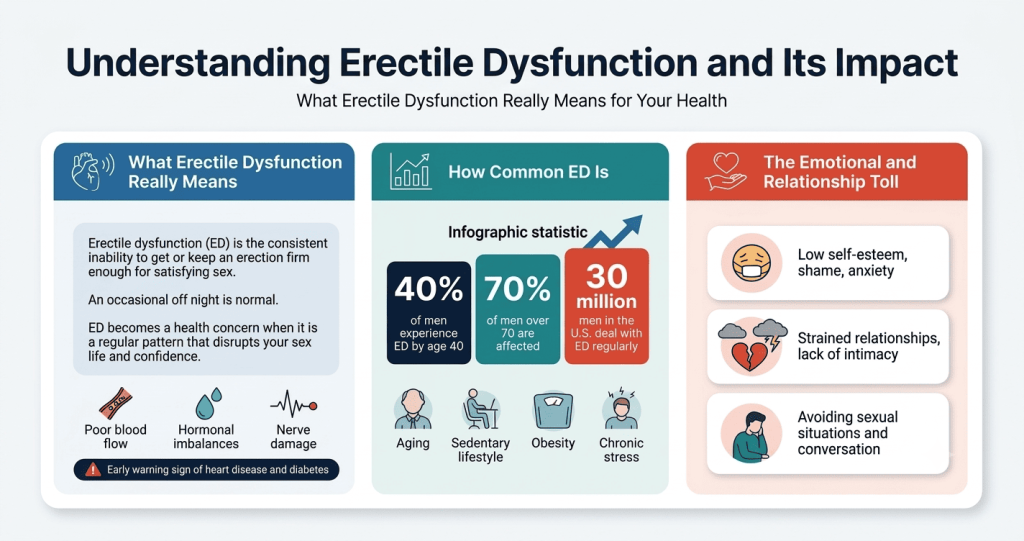
Erectile dysfunction (ED) is the consistent inability to get or keep an erection firm enough for satisfying sex. The key word here is consistent — an occasional off night is normal. ED becomes a health concern when it’s a regular pattern that disrupts your sex life and confidence.
ED is rarely just a bedroom problem. It often signals underlying issues like poor blood flow, hormonal imbalances, or nerve damage — making it an early warning system for conditions like heart disease and diabetes.
How Common ED Is and Why It Affects So Many Men
ED is far more widespread than most men realize:
- 40% of men experience ED by age 40
- 70% of men over 70 are affected
- An estimated 30 million men in the U.S. deal with ED regularly
Aging, sedentary lifestyles, rising obesity rates, and chronic stress all contribute to these numbers
climbing steadily.
The Emotional and Relationship Toll of ED
ED cuts deeper than physical function. Men dealing with it often report:
- Shame and embarrassment that keeps them from seeking help
- Anxiety and depression that create a frustrating cycle
- Relationship tension — partners can misread ED as lost attraction
Ignoring the emotional side of ED only makes recovery harder.
Identifying the Root Causes of Erectile Dysfunction
Physical Conditions That Trigger ED
Most ED cases trace back to physical health issues, especially problems affecting blood flow and nerve signals.
- Cardiovascular disease – narrowed arteries reduce blood flow to the penis
- Type 2 diabetes – damages nerves and blood vessels over time
- High blood pressure – stiffens arteries, limiting circulation
- Obesity – lowers testosterone and strains the vascular system
- Low testosterone – reduces sexual drive and erectile response
- Neurological disorders – Parkinson’s, MS, or spinal injuries disrupt nerve signaling
Psychological Factors That Contribute to ED
The brain plays a huge role in arousal. Stress, anxiety, and depression can short-circuit the entire process before it starts. Performance anxiety — worrying about whether you’ll get or keep an erection — often creates a self-fulfilling cycle.
Lifestyle Habits That Worsen Erectile Function
| Habits | How It Hurts |
|---|---|
|
Smoking |
Damages blood vessel walls |
|
Heavy alcohol use |
Suppresses the nervous system |
|
Sedentary lifestyle |
Reduces circulation and testosterone |
|
Poor sleep |
Lowers hormone production |
Medications and Treatments That May Cause ED
Several common medications list ED as a side effect:
- Antidepressants (SSRIs)
- Beta-blockers and diuretics
- Anti-androgens used in prostate cancer treatment
- Certain antihistamines and sedatives
Recognizing the Warning Signs and Symptoms
Early Signs That Should Not Be Ignored
ED rarely shows up overnight. Watch for these early red flags:
- Weaker erections – You get hard, but not as firm as before
- Slower arousal – It takes noticeably longer to respond to stimulation
- Difficulty maintaining an erection – Things start well but fade quickly
- Reduced morning erections – A drop in frequency or firmness of spontaneous erections
- Decreased sexual desire – Lower libido often walks hand-in-hand with early ED
These signs are easy to brush off as tiredness or stress, but they’re your body waving a flag worth
paying attention to.
When Occasional Issues Become a Serious Concern
| Situation | Likely Cause | Action Needed |
|---|---|---|
|
Happens once or twice |
Stress, alcohol, fatigue |
Monitor only |
|
Happens 25% of the time |
Mild ED developing |
Lifestyle review |
|
Happens 50%+ of the time |
Moderate to severe ED |
See a doctor |
|
Sudden complete loss |
Vascular or nerve issue |
Urgent medical attention |
A rough night happens to almost every man. But when the problem shows up consistently over 4–6 weeks, that’s when a conversation with your doctor stops being optional and starts being necessary.
Getting an Accurate Diagnosis
When to See a Doctor About ED
If ED happens occasionally, stress or fatigue is likely the culprit. But if it’s a regular pattern — happening more than half the time — that’s your cue to book an appointment. Don’t wait years. ED can be an early warning sign of heart disease or diabetes.
Medical Tests Used to Identify the Cause
Your doctor will use a combination of approaches to pinpoint what’s going on:
| Test | What It Checks |
|---|---|
|
Blood tests |
Testosterone, blood sugar, cholesterol |
|
Urinalysis |
Kidney function, diabetes markers |
|
Ultrasound |
Blood flow to the penis |
|
Nocturnal erection test |
Whether erections occur during sleep |
|
Psychological screening |
Anxiety, depression, relationship stress |
Most causes become clear after basic bloodwork and a physical exam.
How Honest Communication With Your Doctor Speeds Up Recovery
Doctors hear about ED constantly — there’s nothing to be embarrassed about. The more specific you
are, the faster you’ll get answers.
Be ready to share:
- When the problem started
- How often it occurs
- Any medications you’re currently taking
- Stress levels or relationship changes
- Any pain or other symptoms
Holding back details delays the right treatment. Your doctor can only work with what you tell them.
Proven Medical Treatments That Restore Sexual Function
Oral Medications and How They Work
PDE5 inhibitors are the go-to first-line treatment for ED. These drugs boost blood flow to the penis by blocking an enzyme that restricts circulation.
| Medication | Onset | Duration |
|---|---|---|
|
Sildenafil (Viagra) |
30–60 min |
4–6 hrs |
|
Tadalafil (Cialis) |
30 min |
Up to 36 hrs |
|
Vardenafil (Levitra) |
30–60 min |
4–5 hrs |
They require sexual stimulation to work and aren’t suitable for men taking nitrates.
Hormone Therapy Options for ED
When low testosterone drives ED, testosterone replacement therapy (TRT) can make a real difference.
Options include injections, patches, gels, and pellets. A blood test confirms whether this route makes sense.
Surgical Interventions for Severe Cases
When other treatments fail, penile implants offer a permanent fix. Two main types exist:
- Inflatable implants – mimic natural erections via a pump mechanism
- Malleable implants – semi-rigid rods that can be manually adjusted
Satisfaction rates among men who choose implants are consistently high.
Vacuum Devices and Other Physical Aids
Vacuum erection devices (VEDs) create negative pressure around the penis, drawing blood in. A constriction ring holds the erection in place. They’re non-invasive, drug-free, and effective for many men
Natural and Lifestyle Approaches That Improve ED
Exercise and Diet Changes That Boost Erectile Health
Regular physical activity directly improves blood flow, which is the foundation of strong erections. Aim for
these proven approaches:
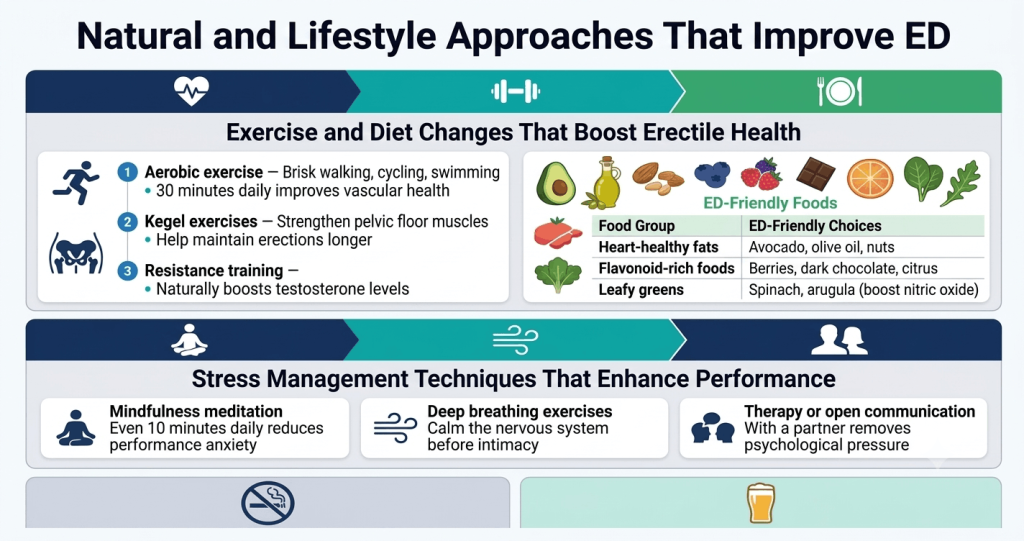
- Aerobic exercise (brisk walking, cycling, swimming) 30 minutes daily improves vascular health
- Kegel exercises strengthen pelvic floor muscles, helping maintain erections longer
- Resistance training naturally boosts testosterone levels
Diet changes matter just as much:
| Food Group | ED-Friendly Choices |
|---|---|
|
Sildenafil (Viagra) |
30–60 min |
|
Tadalafil (Cialis) |
30 min |
|
Vardenafil (Levitra) |
30–60 min |
Stress Management Techniques That Enhance Performance
Chronic stress spikes cortisol, which tanks testosterone and tightens blood vessels. Practical techniques
that actually work:
- Mindfulness meditation (even 10 minutes daily) reduces performance anxiety
- Deep breathing exercises calm the nervous system before intimacy
- Therapy or open communication with a partner removes psychological pressure
How Quitting Smoking and Reducing Alcohol Helps
Smoking damages the blood vessels supplying the penis — sometimes permanently. Quitting shows
measurable improvement within weeks. Alcohol acts as a depressant, dulling nerve signals and reducing
testosterone. Keeping intake below two drinks daily protects erectile function long-term.
Supporting Mental Health to Overcome ED
Therapy Options That Address Psychological ED
Psychological ED responds really well to targeted therapy. The most effective options include:
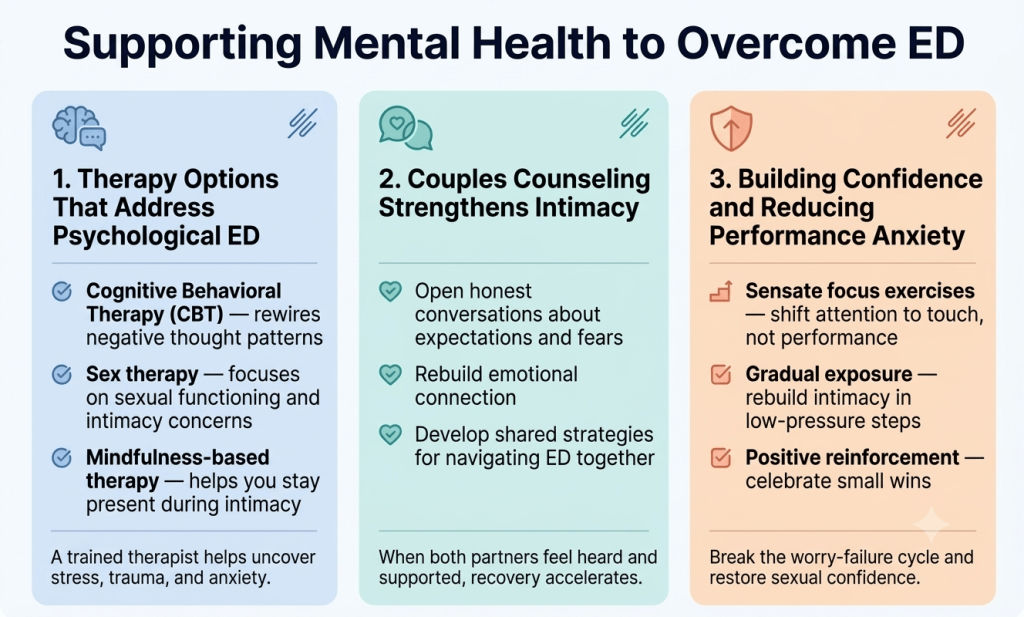
- Cognitive Behavioral Therapy (CBT) – rewires negative thought patterns around sex and self-worth
- Sex therapy – focuses specifically on sexual functioning and intimacy concerns
- Mindfulness-based therapy – helps you stay present during intimacy instead of spiraling into anxious
thoughts
A trained therapist helps uncover hidden stressors, past trauma, or deep-seated anxiety that medications
simply can’t fix.
How Couples Counseling Strengthens Intimacy and Recovery
ED rarely affects just one person. A partner’s reaction — whether frustration or withdrawal — can make
performance anxiety much worse. Couples counseling creates a safe space to:
- Open honest conversations about expectations and fears
- Rebuild emotional connection that fuels physical intimacy
- Develop shared strategies for navigating ED together
When both partners feel heard and supported, recovery genuinely accelerates.
Building Confidence and Reducing Performance Anxiety
Performance anxiety feeds a vicious cycle — you worry about failing, and that worry causes failure.
Breaking it requires:
Sensate focus exercises – removes pressure by shifting attention to touch rather than performance
Gradual exposure – rebuilding intimacy in low-pressure steps
Positive reinforcement – celebrating small wins to restore sexual confidence naturally
Erectile dysfunction is more common than most men realize, and the good news is that it’s very much treatable. From understanding the root causes and spotting early warning signs to exploring medical treatments, lifestyle changes, and mental health support, there are plenty of paths forward. No single approach works for everyone, but with the right diagnosis and a willingness to explore your options, real improvement is absolutely within reach.
If ED has been affecting your life or your relationship, the best first step is simply talking to a doctor.
There’s no reason to sit with this in silence when effective help is available. Take that step, have the honest conversation, and give yourself the chance to feel like yourself again.

About Dr. Ranjeet Singh
Dr. Ranjeet Singh (B.A.M.S., M.D. –( Samdosh Ayurveda) is the Founder – Samdosh Ayurveda, Male Reproductive & Vajikaran Specialist.
With years of clinical experience and thousands of successful recoveries from erectile dysfunction, premature ejaculation, and infertility, he has earned recognition as one of India’s leading Ayurvedic specialists in male reproductive health.
His mission is to revive ancient Vajikarana science using modern research and pure, standardized herbal formulations.
Dr. Ranjeet believes in treating the whole person — not just the symptom — integrating body, mind, and spirit for complete healing.
“Sexual health is not about performance alone. It’s about balance, mindfulness, and inner energy.
When we treat the root dosha and purify the mind, the body heals itself.”
— Dr. Ranjeet Singh, Founder – Samdosh Ayurveda, Male Reproductive & Vajikaran Specialist