
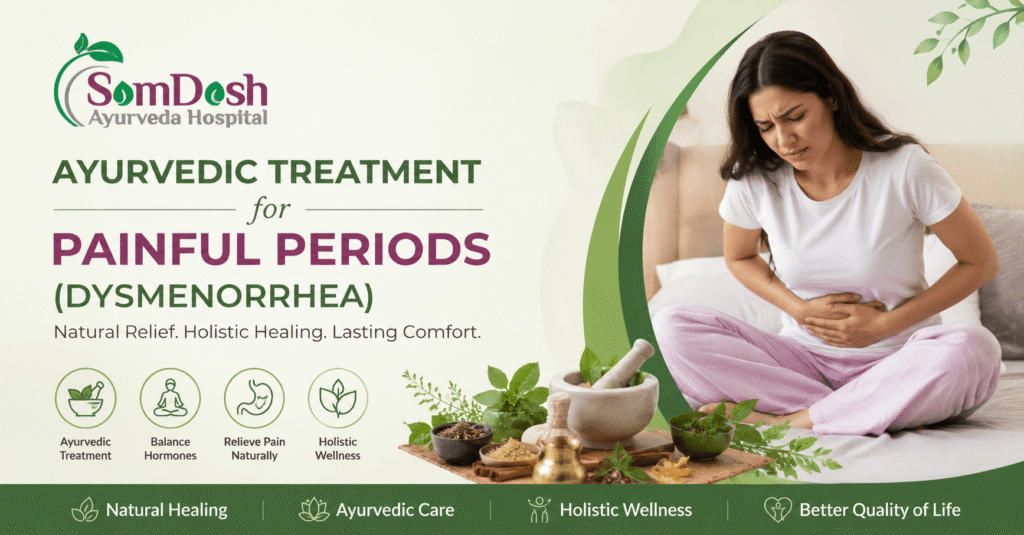
Ayurvedic Treatment for Painful Periods (Dysmenorrhea)

Ayurvedic Treatment for Painful Periods in Noida

Natural | Root Cause | Personalized Treatment

What are Painful Periods?

Painful periods, known medically as dysmenorrhea, refer to menstrual cramps and pain that occur before or during the period. While mild discomfort during menstruation is common, many women experience pain severe enough to disrupt daily life — pain that forces them to miss school or work, curl up in bed, or rely on painkillers every single month. This is not something a woman should simply “tolerate.” Painful periods are a genuine health concern, and in many cases they are completely treatable at the root. 

Dysmenorrhea is broadly of two types: 

• Primary dysmenorrhea — period pain without any underlying disease, caused mainly by the natural chemicals (prostaglandins) that make the uterus contract. This is the more common type. 

• Secondary dysmenorrhea — period pain caused by an underlying condition such as endometriosis, fibroids, adenomyosis, PCOS, or pelvic infections. This type often worsens over time and needs deeper evaluation. 

This concern affects a very large proportion of menstruating women, especially teenagers and young adults. And cases of severe, worsening period pain are being seen more often today — linked to stress, poor diet, sedentary lifestyle, obesity, and rising rates of conditions like endometriosis and PCOS. 

In Ayurveda, menstruation is governed primarily by Apana Vata — the sub-dosha responsible for the downward flow in the pelvis, including menstrual flow. Painful periods (described within Kashtartava / Yonivyapada) are seen mainly as a disorder of aggravated Vata, which causes painful, obstructed, or spasmodic flow, often combined with Pitta (heat, heavy bleeding, inflammation) or Ama (toxins) blocking the channels. This is why calming and regulating Apana Vata is central to Ayurvedic relief from period pain.

Common Symptoms of Painful Periods

• Cramping or throbbing pain in the lower abdomen, before or during the period
• Pain radiating to the lower back and thighs
• Pain severe enough to disturb daily activities or need painkillers
• Nausea, vomiting, or loose motions with the pain
• Headache, dizziness, or fatigue during periods
• Bloating and heaviness in the lower abdomen
• In secondary dysmenorrhea — heavy or irregular bleeding, pain during intimacy, or pain outside the period days (possible signs of an underlying condition)

If your period pain is severe, worsening over time, or accompanied by heavy/irregular bleeding, it is important to get properly evaluated rather than only managing it with monthly painkillers.

Root Causes of Painful Periods

Modern causes:

• Prostaglandins — natural chemicals that cause the uterus to contract strongly, driving primary period pain
• Underlying conditions — endometriosis, adenomyosis, fibroids, PCOS, or pelvic infections (secondary dysmenorrhea)
• Hormonal imbalance — disturbed estrogen–progesterone balance
• Stress and anxiety — heighten pain perception and disturb hormones
• Poor diet and lifestyle — cold, processed, and inflammatory foods; lack of exercise
• Obesity and sedentary habits — worsen inflammation and hormonal balance
• Nutritional deficiencies — such as magnesium, and others linked to muscle cramping

Ayurvedic causes (Dosha imbalance):

• Apana Vata aggravation — the central cause; disturbed downward flow leads to spasmodic, cramping, obstructed, and painful menstruation. Cold, dry, irregular, and stressful lifestyles aggravate Vata.
• Pitta involvement — links to heat, heavy or excessive bleeding, burning, and inflammation; aggravated by spicy, sour, and fermented foods
• Ama (toxin) accumulation — poor digestion produces toxins that block the channels (Srotas), obstructing free flow and intensifying pain
• Weak Agni and poor Dhatu nourishment — leading to overall reproductive weakness
• Manasika (mental) factors — stress and anxiety strongly aggravate Vata and worsen pain

The Ayurvedic advantage is that instead of only numbing the pain with a monthly painkiller, it regulates Apana Vata, clears Ama, balances Pitta, and corrects the diet and lifestyle causing the imbalance — so periods gradually become less painful naturally, month after month.

Why Choose Ayurvedic Treatment for Painful Periods?

• Root cause healing — regulates the menstrual physiology instead of just masking pain
• No painkiller dependence, no side effects — natural, herbal, and lifestyle-based relief
• Long-term results — periods tend to become progressively less painful over cycles
• Personalized treatment — matched to your dosha, cycle pattern, and any underlying condition
• Confidential, women-centred care — comfortable consultation under a woman doctor

Our Ayurvedic Treatment for Painful Periods

Step 1: Diagnosis

• Detailed history — pain pattern, cycle regularity, flow, associated symptoms, and any signs pointing to an underlying condition
• Nadi Pariksha and Prakriti assessment to identify the dosha involved
• Guidance on relevant evaluation where needed — such as ultrasound and hormone tests — to rule out endometriosis, fibroids, PCOS, or other causes of secondary dysmenorrhea

Step 2: Customized Plan

• Ahara (diet) — a Vata-pacifying, warm, nourishing diet; warm water and herbal teas; reducing cold, dry, processed, and inflammatory foods; specific dietary guidance around the cycle
• Vihara (lifestyle) — rest and self-care during menstruation, gentle exercise and yoga (very helpful for period pain), stress management, and a regular routine to balance Apana Vata

Step 3: Medicines

• Classical formulations to regulate Apana Vata, ease cramping, balance Pitta, clear Ama, and support reproductive health — using time-tested herbs such as Ashoka, Shatavari, Dashamoola, Ajwain, and other Vata-pacifying and uterine-tonic preparations selected for your case
• Medicines are individualized; self-medication is discouraged

Step4: Panchakarma (if needed)

• Vata-balancing therapies such as Basti (the prime treatment for Vata), Abhyanga, and specialized therapies like Uttar Basti in selected cases of secondary dysmenorrhea, under expert supervision

How Long Does Treatment Take?

Because menstruation is a monthly cycle, improvement is measured cycle by cycle.
• First cycle: relief measures and lifestyle changes often reduce the severity of the very next period
• 2–3 cycles: noticeable, progressive reduction in pain in most cases of primary dysmenorrhea
• 3–6 cycles: significant, lasting improvement as the physiology rebalances
• Secondary dysmenorrhea (endometriosis, fibroids, adenomyosis) needs longer, sustained treatment and management of the underlying condition, which we guide honestly

The aim is a steady, month-on-month reduction in pain — not a one-time numbing.

Patient Success Stories

Many young women who dreaded their periods every month — depending on painkillers and missing work or college — have found their cycles becoming progressively gentler through root-cause Ayurvedic treatment. These are personal journeys shared only with consent, and select experiences may be available on our YouTube channel.

What Our Patients Are Saying

Nitin Bhattrai
★★★★★
Best Ayurveda Clinic, very polite and friendly staff and doctors.

Sarita Yadav
★★★★★
After treatment for PCOD and fatty liver, I got excellent results.

Ajay Raj
★★★★★
Best place for fatty liver and digestion treatment.

Neha Yadav
★★★★★
Amazing treatment experience. Highly recommended Ayurveda therapies.

Nitin Bhattrai
★★★★★
Best Ayurveda Clinic, very polite and friendly staff and doctors.
Sarita Yadav
★★★★★
After treatment for PCOD and fatty liver, I got excellent results.
Ajay Raj
★★★★★
Best place for fatty liver and digestion treatment.
Neha Yadav
★★★★★
Amazing treatment experience. Highly recommended Ayurveda therapies.

Why Patients Trust Samdosh Ayurveda

• 15,000+ patients treated with complete confidentiality
• Care under a woman doctor for a comfortable, respectful experience
• Root cause approach that reduces pain over cycles instead of masking it
• Personalized care with private consultation and regular follow-up

Doctor for Painful Periods

Dr. Megha Yadav is an experienced Ayurvedic physician at Samdosh Ayurveda, Noida, focusing on women’s health and gynaecological conditions. She treats painful periods with a root-cause approach — carefully distinguishing primary from secondary dysmenorrhea, regulating Apana Vata, and correcting diet and lifestyle — so that periods become progressively less painful. She is also careful to evaluate for underlying conditions like endometriosis and fibroids where the pattern suggests them.

Frequently Asked Questions

1. Can Ayurveda permanently cure painful periods?

In primary dysmenorrhea (period pain without an underlying disease), root-cause treatment can genuinely make periods progressively less painful and sustain that relief with a corrected lifestyle. Secondary dysmenorrhea needs the underlying condition managed too, which we guide honestly.

Mild discomfort is common, but pain severe enough to disrupt daily life or requiring painkillers every month is not something to simply tolerate. It deserves proper evaluation and treatment.

Many women feel relief in the very next cycle, with progressive, lasting improvement usually over 2 to 6 cycles.

Treatment is herbal, personalized, and non-habit-forming — unlike monthly painkiller dependence. It is prescribed and monitored by qualified doctors.

If your period pain is severe, worsening over time, or comes with heavy/irregular bleeding, pain during intimacy, or pain outside period days, it may point to an underlying condition and should be evaluated.

Warm, nourishing, Vata-pacifying foods, warm water, gentle yoga, adequate rest, and stress management help significantly, while cold, processed, and inflammatory foods worsen pain. Your exact plan is customized.

Disclaimer:

This article is for educational purposes and is not a substitute for medical consultation. Severe or worsening period pain should be evaluated for underlying conditions. Results vary from person to person. Please consult a qualified doctor before starting any treatment.

Our Latest Blogs:

Struggling With IBS? Discover Natural Ayurvedic Relief For IBS

Struggling With IBS? Discover Natural Ayurvedic Relief For IBS Living with Irritable Bowel Syndrome (IBS) can feel exhausting. Frequent stomach...
What Ayurveda Says About Erectile Dysfunction – Foods & Lifestyle That Truly Help!

What Ayurveda Says About Erectile Dysfunction – Foods & Lifestyle That Truly Help! A SILENT STRUGGLE MEN ARE AFRAID TO...
PCOD vs PCOS: What’s the Difference & How to Treat It Naturally

PCOD vs PCOS: What’s the Difference & How to Treat It Naturally Why PCOD & PCOS Are Rising Rapidly PCOD...

Scroll to Top