Why PCOD & PCOS Are Rising Rapidly
PCOD and PCOS have become some of the most common yet misunderstood hormonal disorders affecting women today. What was once considered a problem of late reproductive age is now frequently diagnosed in teenagers and young women in their early twenties.
Irregular periods, acne, unwanted facial hair, weight gain, mood swings, and infertility are often treated as isolated symptoms. In reality, they are warning signs of a deeper metabolic and hormonal imbalance.
This article explains PCOD vs PCOS clearly, combines modern medical science with classical Ayurveda, and explains how Samdosh Ayurveda treats PCOD/PCOS at the root level instead of suppressing symptoms.
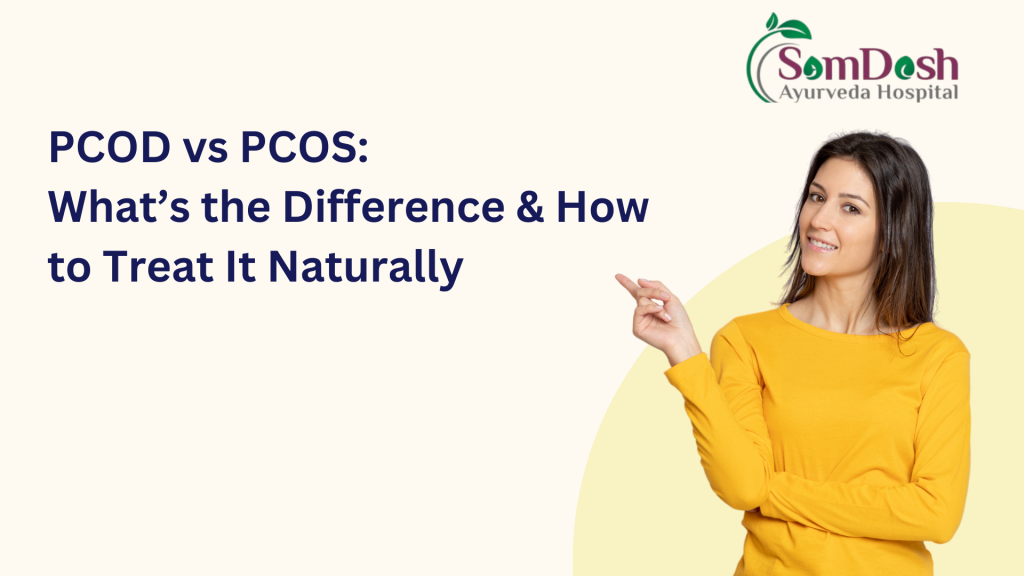
PCOD vs PCOS: Are They Really Different?
What Is PCOS?
PCOS (Polycystic Ovary Syndrome) is a systemic endocrine and metabolic disorder. According to modern diagnostic criteria, PCOS is identified when at least two of the following are present:
Irregular or absent ovulation
Excess androgen hormones
Polycystic ovaries on ultrasound
PCOS affects ovaries, metabolism, insulin function, mental health, and long-term cardiovascular risk.
What Is PCOD?
PCOD (Polycystic Ovarian Disease) is a commonly used clinical term, especially in India. It usually indicates ovarian dysfunction due to hormonal imbalance, often triggered by lifestyle factors.
In practical terms:
- PCOD is often functional and reversible
- PCOS is chronic, systemic, and metabolic
Ayurveda does not treat these labels differently — it treats the imbalance behind them.
Global & Indian Statistics on PCOS
- 6–13% of reproductive-age women globally suffer from PCOS
- Nearly 70% remain undiagnosed
- PCOS prevalence has more than doubled since 1990
- India carries one of the highest burdens due to sedentary lifestyle and dietary shifts
PCOS is now among the leading causes of female infertility worldwide.
What Causes PCOD & PCOS? (Modern Science Simplified)
The most important drivers include:
Insulin Resistance
High insulin stimulates excess androgen production, disturbing ovulation.
Hormonal Dysregulation
Imbalanced LH, FSH, estrogen, progesterone, and testosterone.
Chronic Inflammation
Low-grade inflammation worsens ovarian response.
Genetic + Lifestyle Interaction
Genes load the gun, lifestyle pulls the trigger.
Symptoms of PCOD & PCOS You Should Not Ignore
- Irregular or absent periods
- Acne, oily skin
- Facial or body hair growth
- Hair thinning
- Weight gain (especially abdominal)
- Dark skin patches
- Mood swings, anxiety
- Difficulty conceiving
How PCOS Is Diagnosed in Modern Medicine
Diagnosis involves:
- Clinical history and examination
- Blood tests (hormones, insulin, glucose, lipids)
- Pelvic ultrasound
⚠️ Ovarian cysts alone do not confirm PCOS.
- Clinical history and examination
Why Only Hormonal Pills Are Not Enough
Most conventional treatments aim to control symptoms, not correct causes.
Hormonal pills may:
- Regulate bleeding
- Reduce acne temporarily
But they do not correct insulin resistance, metabolic toxicity, or ovarian signaling. Once stopped, symptoms often return.
This is where Ayurveda offers a root-cause solution.
- Regulate bleeding
How Ayurveda Understands PCOD & PCOS
Ayurveda views PCOD/PCOS as a disorder involving:
- Aartava Dushti – menstrual dysfunction
- Meda Dushti – fat & insulin imbalance
- Agnimandya – weak digestion
- Ama – metabolic toxins
- Srotorodha – blocked reproductive channels
This understanding naturally leads to systemic detoxification and metabolic correction, not just cycle regulation.
- Aartava Dushti – menstrual dysfunction
Dosha Imbalance in PCOD & PCOS
- Kapha → cysts, weight gain, sluggish ovaries
- Vata → irregular cycles, hormonal miscommunication
- Pitta → acne, hair fall, inflammation
Most PCOS patients show Vata-Kapha dominance, which requires cleansing before nourishment.
Role of Ama, Agni & Srotas in Hormonal Disorders
When digestion is weak:
- Ama accumulates
- Hormonal channels get blocked
- Ovulation signals fail
Ayurveda therefore emphasizes cleaning first, rebuilding later.
This brings us to the most critical therapeutic pillar in PCOD/PCOS care — Panchakarma.
Why Panchakarma Therapy Is Essential for PCOD & PCOS Patients
PCOD and PCOS are not surface-level hormonal issues. They are deep metabolic disorders involving insulin resistance, inflammation, and blocked endocrine communication.
No oral medicine alone can clear these blockages.
Panchakarma is Ayurveda’s medical detoxification and hormonal reset therapy, designed to remove deep-seated toxins (Ama) and restore natural endocrine rhythm.
How Panchakarma Works in PCOD & PCOS (Step-by-Step)
1. Snehana (Oleation Therapy)
Medicated oils or ghee are used to loosen toxins from deep tissues.
Benefits:
- Improves hormonal receptor sensitivity
- Nourishes ovaries
- Balances Vata
2. Swedana (Therapeutic Steam)
Controlled herbal steam opens blocked channels.
Benefits:
- Improves ovarian circulation
- Reduces insulin resistance
- Supports weight reduction
3. Virechana (Therapeutic Purgation)
This is one of the most important therapies for PCOS.
Why?
The liver is responsible for hormone metabolism. Virechana cleanses liver-gut pathways.
Results:
- Better estrogen clearance
- Reduced acne and hair fall
- Improved menstrual regularity
4. Basti Therapy (Medicated Enema) – The Core Treatment
In Ayurveda, Vata controls the endocrine system, and Basti is the best Vata therapy.
Benefits of Basti in PCOD/PCOS:
- Restores ovulation signaling
- Improves brain-ovary communication
- Corrects gut-hormone axis
- Stabilizes insulin response
Many patients begin ovulating naturally after a properly designed Basti protocol.
Panchakarma Is Not a Spa Detox
Regular Detox | Panchakarma |
Short-term | Deep systemic |
General | Personalized |
Temporary | Long-lasting |
No hormonal reset | True endocrine correction |
When Is Panchakarma Strongly Recommended?
- PCOS for more than 2 years
- Absent periods for months
- Weight not reducing
- Failed fertility treatments
- Long-term hormonal pill use
Results After Panchakarma (With Proper Follow-Up)
- Improved digestion & metabolism
- Gradual weight loss
- Reduced cyst size
- Regular menstrual cycles
- Improved ovulation
- Better emotional stability
Diet for PCOD & PCOS According to Ayurveda
Recommended:
- Warm, freshly cooked meals
- Millets, barley, oats
- Seasonal vegetables
- Moderate healthy fats
Avoid:
- Sugar & refined flour
- Cold drinks
- Processed food
- Late-night eating
- Warm, freshly cooked meals
PCOS, Weight Gain & Insulin Resistance
Ayurveda treats metabolism first, not calories.
Weight loss becomes a side effect of healing, not punishment.
PCOS and Infertility: Ayurvedic Perspective
By restoring:
- Ovulation
- Uterine health
- Hormonal rhythm
Many women conceive naturally after treatment.
How Samdosh Ayurveda Treats PCOD & PCOS
At Samdosh Ayurveda, treatment includes:
- Modern + Ayurvedic diagnosis
- Personalized medicines & diet
- Panchakarma when indicated
- Continuous monitoring
Under Dr. Ranjeet Singh, Founder – Samdosh Ayurveda, who has treated 45,000+ patients, the approach focuses on root-cause healing, not symptom suppression.
How Long Does Treatment Take?
- Early improvement: 4–8 weeks
- Cycle regulation: 3–6 months
Fertility outcomes: individualized
Can PCOS Be Reversed?
PCOS can be metabolically reversed and hormonally stabilized with sustained Ayurvedic care and lifestyle correction.

About Dr. Megha Yadav
Dr. Megha Yadav Singh (BAMS) specializes in:
- PCOS & PCOD
- Menstrual irregularities
- Hormonal imbalance
- Lifestyle-related metabolic disorders
At Samdosh Ayurveda, she focuses on root-cause healing, not temporary symptom suppression.
PCOD and PCOS are not lifelong curses. They are reversible metabolic signals when addressed correctly.
Ayurveda does not force hormones.
It restores balance — permanently.